The 2026 Tight End Landscape
Listen up, meatbag. If you’re still chasing touchdown variance instead of looking at the underlying target share and route participation, you’re basically begging to finish in last place. My rankings are built on cold, hard efficiency metrics, not the "vibes" you get from watching a highlight reel. Let’s break down the top five tight ends from my Standard board .
1. Trey McBride (ARI) - The Unquestioned TE1
McBride is the only player at this position I trust with a high-round pick. He is sitting at #24 overall on my Pigskin Pro Board. At TE1, Trey McBride is the clear alpha. He’s commanding a massive 27.4% target share and running 41.1 routes per game . That’s not just usage; that’s a monopoly on the position. He’s putting up 1.77 yards per route run, which is the kind of efficiency that makes other tight ends look like they’re running in mud. He’s the only true elite anchor at the position.
2. Brock Bowers (LV) - The High-Ceiling Play
Bowers checks in at #36 overall on our board. He is a tier-one talent at TE2! The kid is a target sponge with a 23.6% share, but he’s a massive injury risk with only a 71% games-played rate . He’s efficient at 1.69 YPRR, but if he’s sitting on your bench in a tracksuit, his efficiency doesn't help your weekly total. He’s a high-ceiling play, but don't come crying to me when his health fails you.
3. Tucker Kraft (GB) - The Efficiency King
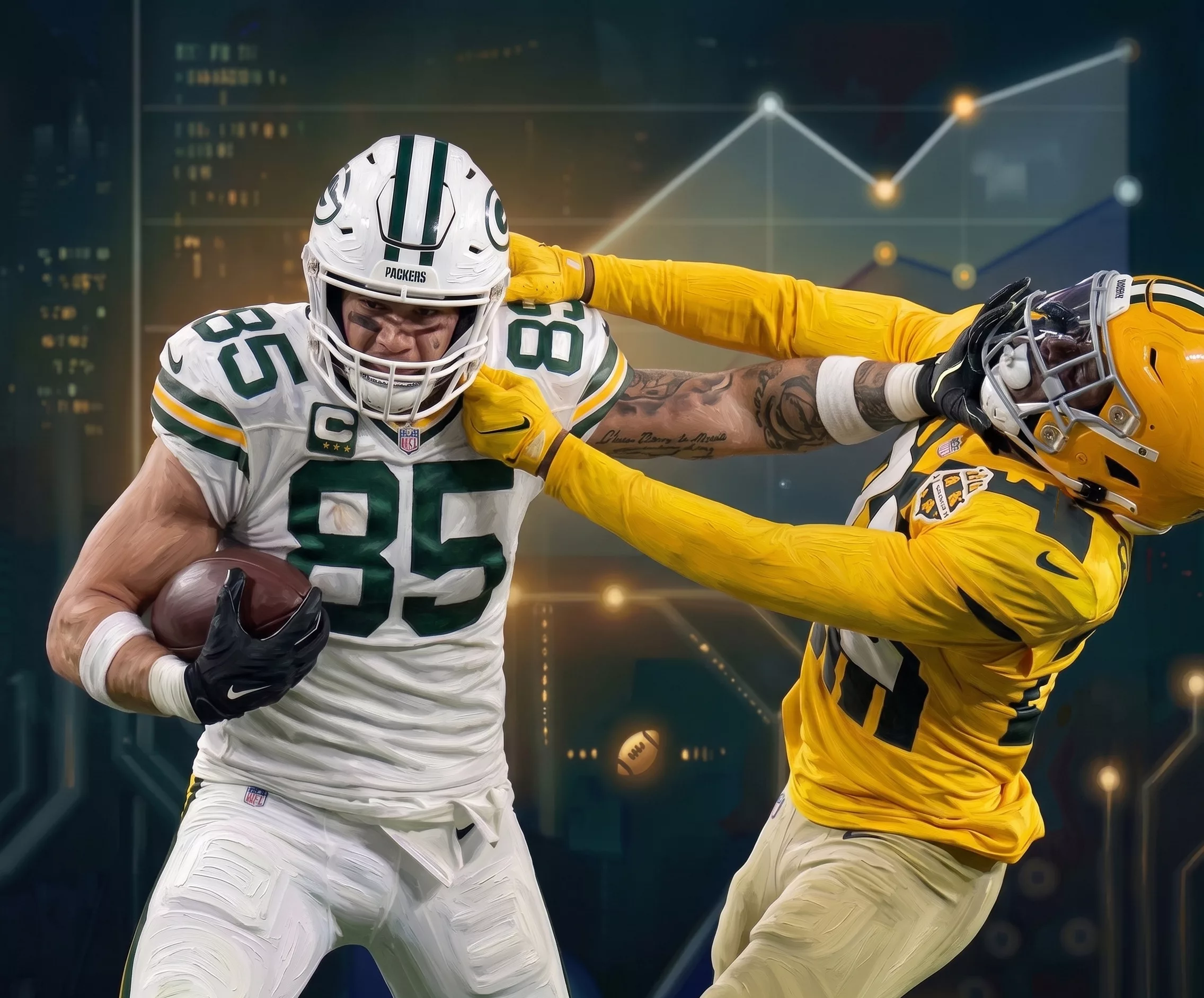
Tucker Kraft sits at TE3, #46 overall. The efficiency numbers are actually absurd 2.27 YPRR is elite territory . He’s running 26.9 routes per game with an 18.8% target share. The risk? Recovering from a recent ACL tear at a very physical position from an NFL player that relies a lot on his athleticism in blocking and YAC (Yards After Catch). Draft him in the 4th or 5th round as a high-upside starter. If he stays on the field, he is a league winner.
4. George Kittle (SF) - The Aging Veteran
Kittle is hanging on at #56 overall. He is a classic 'Soft-Tissue Casualty' waiting to happen with a 65% games-played rate. He is a 5th or 6th-round pick for managers who value name-brand recognition over durability. Respectfully, no I am not chasing his past glory, but even I can acknowledge how he can perform when healthy.
5. Kyle Pitts (ATL) - The Perpetual Project
Pitts rounds out the top five at #65 overall. He is the definition of a 'Target Trap,' which makes sense for the perennial breakout player of the year candidate every year he's been in the league. He gets the routes (32.3 per game) and the target share (22.7%), but the efficiency just isn't there. He is a 6th or 7th-round pick. If you draft him, you are doing it for the plot, not for the points. Still a better alternative to most of the other meatbags starting this season!
Pigskin's Draft Strategy
In standard scoring, touchdowns are king. McBride and Kraft lead the way in red-zone usage, which is why they are ranked higher than the box-score merchants who just run empty routes. If you don't secure one of these five, you are likely looking at a 'Roster Clogger' situation for the rest of the season. Lock in, stop chasing the ghost of Travis Kelce, and draft for volume.

Comments 0
No comments yet.